Summary
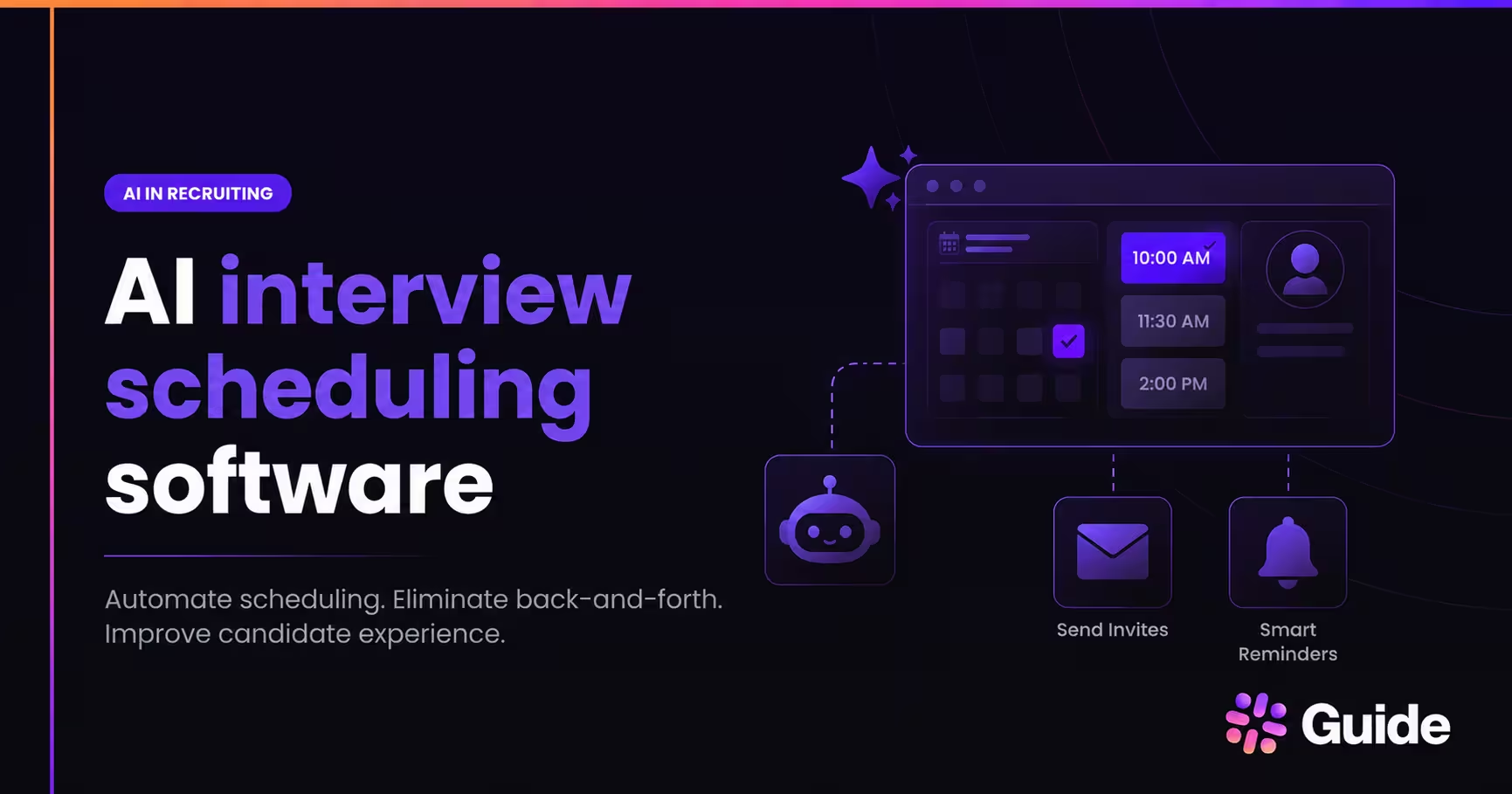
AI interview scheduling software automates finding interview times across multiple calendars, resolving conflicts, and sending candidate updates. In 2026, 35% of recruiters' time went to scheduling, and 42% of companies had adopted AI for it. It differs from an ATS by focusing only on the scheduling layer. Guide's AI Scheduler helps teams coordinate up to 7x faster than manual methods.
Why interview scheduling became a software problem worth solving with AI
According to a 2026 recruiting statistics report from SelectSoftwareReviews, 35% of recruiters' time goes to interview scheduling alone, and 42% of companies have already adopted some form of AI for interview scheduling as a result. That shift did not happen because scheduling is glamorous technology. It happened because the volume kept climbing while the tools stayed roughly the same: a shared calendar, a scheduling link, an inbox full of back-and-forth availability emails.
The same report found that 60% of companies saw their time-to-hire get longer in 2024, up from 44% in 2023, and 27% of talent acquisition leaders now describe their team's workload as unmanageable, up from 20% the year before. Scheduling is rarely the only cause of a slower hiring process, but it is one of the few parts of that process software can meaningfully fix, which is exactly why this category grew up around it.
Core features of AI interview scheduling software
Strip away the branding and most tools in this category are built to handle the same core jobs, just with different levels of sophistication:
- Multi-calendar availability matching. Reading a candidate's calendar, several interviewers' calendars, and a hiring manager's calendar at once, and finding a slot that works for all of them rather than just two people.
- Automated conflict resolution. When an interviewer declines or a meeting gets bumped, finding a replacement time or interviewer automatically instead of routing it back to a human.
- ATS-native integration. Working inside the applicant tracking system a team already uses, so scheduling updates candidate status and stays in sync with the rest of the pipeline, instead of living in a separate tool.
- Candidate-facing communication. Sending confirmations, reminders, and prep information that feel like part of a company's hiring process rather than a generic calendar invite.
- Interviewer load balancing. Distributing interviews across a qualified interviewer pool so the same few people are not carrying the whole panel schedule.
- Reporting and analytics. Surfacing time-to-schedule, reschedule rates, and other coordination metrics so a team can see where the process is actually slowing down.
- Security and compliance. Handling candidate and employee data the way any HR system should, including certifications like SOC 2 and compliance with regulations like GDPR.
What to look for when evaluating AI interview scheduling software
Not all tools in this category solve the same problems equally well. A few questions tend to separate the tools built for real coordination complexity from the ones built for simple one-on-one booking:
- Does it handle multi-person panels, not just 1:1 meetings? A five-person panel loop is a fundamentally different scheduling problem than booking a single call.
- Does it integrate natively with your ATS, or does it just sync calendars? Calendar sync alone will not update candidate stages or keep your pipeline data accurate.
- How does it handle a decline or a conflict? Look for automatic rebooking and interviewer swaps, not a notification that tells a coordinator to start over manually.
- Does it give candidates a branded, guided experience? A generic calendar invite is a missed opportunity to reinforce a company's employer brand at a moment candidates are paying close attention.
- Can it scale interviewer training and load balancing? As a team grows, someone needs to track who is trained on what and make sure interview load stays even.
- What reporting does it expose? Time-to-schedule, reschedule rates, and decline reasons are the metrics that tell a team where coordination is actually breaking down.
- What security certifications does it hold? SOC 2 and GDPR compliance are reasonable baseline expectations for any tool touching candidate data.
- How long does rollout actually take? Tools that require every interview requirement to be configured manually upfront tend to take much longer to roll out than ones that learn from behavior over time.
How our AI Scheduler works
This is the exact problem we built our AI Scheduler to solve. Our goal is to eliminate manual scheduling work and increase coordination speed, and we do it with what we believe is the deepest ATS integration available in this category, built to decrease time-to-schedule and make recruiters, coordinators, and interviewers happier in the process. Teams using Guide coordinate up to 7x faster than they did with manual, spreadsheet-and-email scheduling, and most teams using typical interview scheduling tools still waste over 40% of their time on manual tasks even when those tools are supposed to be automated.
What it automates
- Availability requests and confirmations. Aria automates the repetitive back-and-forth of collecting availability and confirming interviews, so a coordinator is not manually sending and chasing emails.
- Conflict resolution and time zone tracking. AI-enhanced conflict resolution and interviewer preferences find more viable interview times and reduce reschedules, even across time zones.
- Multi-day, virtual, and hybrid panels. Our scheduler is purpose-built for complex panel logic, and it learns from previously scheduled panels to auto-save them as repeatable templates.
- Interviewer selection and load balancing. We match interviewers based on expertise, focus, and team alignment, and automate load balancing so the same interviewers are not overloaded.
- Interviewer training pools. We track interviewer training paths from first shadow to fully trained, and automatically schedule shadow and reverse-shadow sessions.
- Collaborative ticketing. Our shared ticketing queue gives coordination teams full visibility into scheduling tasks, whether they work from their ATS or our dedicated dashboard.
- Branded candidate communication. Interview schedules, interviewer bios, and prep information go out automatically, and we surface real-time analytics on candidate conversations so you know your message was received.
Where it fits in your stack
We integrate with the tools recruiting teams already use day to day, including Greenhouse for the ATS, Gmail for email, Google Calendar, Slack for messaging, Zoom for video, and CoderPad for assessments.
Who this is built for
We built Guide for a specific kind of team: recruiting operations and coordination teams running high volumes of interviews, often with complex, multi-person panels, tight time-to-hire targets, and a strong focus on candidate experience. Teams at GitLab, Netlify, MongoDB, Glossier, Strava, and NexHealth, among others, use Guide today.
If your hiring process is simple, low-volume, or handled by a single recruiter with a basic scheduling link, a full AI interview scheduling platform may be more than you need right now. We built Guide for teams where scheduling itself has become the bottleneck.
What our customers say
Elle Loberternos, Talent Operations Manager at Strava, told us: "We've used every scheduling tool on the market and Guide is far and away our favorite. We are superfans."
Cristina Disch, Global Candidate Experience Manager at MongoDB, told us: "There was a pre-Guide MongoDB and a post-Guide MongoDB. Coordination and candidate experience was extremely painful before you guys came along."
You can read more customer stories on our customer stories page.
Security and compliance
We are SOC 2 audited and certified, GDPR and CCPA compliant, and we encrypt all data at rest and in transit with strict access controls.
Frequently asked questions
Is AI interview scheduling software the same as an ATS?
No. An applicant tracking system manages the overall hiring pipeline, including job postings, applications, and candidate stages. AI interview scheduling software focuses specifically on the scheduling and coordination layer, and the best tools in this category work natively inside an ATS like Greenhouse rather than replacing it.
Does it work with our existing ATS and calendar tools?
We integrate with Greenhouse for the ATS, Gmail for email, Google Calendar, Slack, Zoom, and CoderPad.
Can it handle multi-day or panel interviews?
Yes. Our scheduler is purpose-built for multi-day panels and virtual and hybrid interviews, and it learns from previously scheduled panels to save them as repeatable templates.
How long does implementation take?
Rather than requiring complex interview requirements to be configured upfront, Aria infers them from each user's behavior and automatically suggests interview requirements to save as templates. The more interviews you schedule through your ATS integration, the more it remembers.
Is it secure?
Yes. We are SOC 2 audited and certified, GDPR and CCPA compliant, and we encrypt all data at rest and in transit.
See it in action
If interview scheduling has become the bottleneck in your hiring process, we would love to show you how our AI Scheduler handles it firsthand. Book a demo or read more about our AI Scheduler and scheduling automation use case.