Summary
An AI recruiting coordinator automates interview scheduling, conflict resolution, and candidate communication across multi-person panels, replacing manual calendar work. Recruiters spend 35% of their time on scheduling, and 42% of companies have adopted AI for it. Unlike a scheduling link tool, which books single meetings, it's built for ATS-linked panel workflows. Guide's Aria increases coordination speed up to 7x.
Why this category exists
Interview scheduling looks like a small problem until it gets measured. According to a 2026 recruiting statistics report from SelectSoftwareReviews, 35% of recruiters' time goes to interview scheduling alone, and 27% of talent acquisition leaders now say their teams are carrying an unmanageable workload, up from 20% the year before. Time-to-hire is moving in the wrong direction too: 60% of companies reported a longer time-to-hire in 2024 than the year prior, up from 44% in 2023, and almost no industry managed to buck that trend.
None of that is because recruiting coordinators are bad at their jobs. It is because the math of coordination gets harder every time a hiring process adds a panel round, a second time zone, or an interviewer with a packed calendar. A single interview needs one open slot. A five-person panel loop needs five people's calendars to line up, backup interviewers on standby for last-minute declines, and a candidate who is kept in the loop the entire time. That is a genuinely hard scheduling problem, which is part of why the same report found 42% of companies have already adopted some form of AI for interview scheduling.
What a recruiting coordinator actually does
Before getting into what changes with AI, it helps to be clear on the job itself. According to AIHR's breakdown of the role, a recruiting coordinator provides administrative support, communicates with candidates, arranges interviews and paperwork, updates candidate records, and works closely with hiring managers to keep the process moving. At a small company, one coordinator might support an entire recruiting team. At a large company running hundreds of interviews a month, coordinators are often split across specialized parts of the process, and scheduling alone can eat most of the week.
That scheduling work is where the job gets hard to scale. Multi-person panels, shifting interviewer availability, time zones, last-minute declines, and constant status updates turn what sounds like a calendar problem into a full-time coordination problem, which is exactly the gap AI recruiting coordinators were built to close.
How an AI recruiting coordinator works
Strip away the branding and most tools in this category are solving the same handful of problems, just with different levels of sophistication:
- Availability matching. Reading multiple calendars at once, not just two, and finding slots that work for a candidate, several interviewers, and a hiring manager simultaneously.
- Conflict resolution. When someone declines or a meeting gets bumped, automatically finding a replacement time or interviewer instead of putting that back on a human's plate.
- Pattern learning. Picking up on recurring signals, like which interviewers are overloaded or which time slots tend to fall through, and adjusting future scheduling accordingly.
- Candidate-facing communication. Sending confirmations, reminders, and updates that feel like part of the hiring process rather than a generic calendar invite.
- ATS and calendar integration. Working inside the tools a recruiting team already uses, such as an applicant tracking system, a calendar, and a messaging tool, instead of becoming one more disconnected tab.
A basic scheduling link, the kind built for booking a single one-on-one meeting, only really needs to solve the first problem. An AI recruiting coordinator has to solve all five at once, continuously, across every open role a company is hiring for, which is why the two categories tend to get compared but rarely get confused once a team has tried both.
Signs your team needs one
Not every hiring team needs a dedicated AI recruiting coordinator. A short hiring process handled by one recruiter with a shared calendar link can work fine without one. The signals that a team has outgrown manual scheduling tend to show up together:
- Interview volume has climbed to the point where scheduling, not sourcing or interviewing, is the actual bottleneck in time-to-hire.
- Panels routinely involve three or more interviewers, often across teams or time zones.
- Coordinators are spending more time re-scheduling than scheduling, because declines and conflicts keep coming in.
- Candidate experience is slipping because updates are inconsistent or slow to go out.
- Several tools, a calendar link, a spreadsheet, an inbox, an ATS, are being stitched together by hand just to make scheduling work at all.
When several of those show up at once, the fix usually is not another calendar tool. It is a system built to run coordination as a workflow, not a series of one-off tasks.
Meet Aria, our AI recruiting coordinator
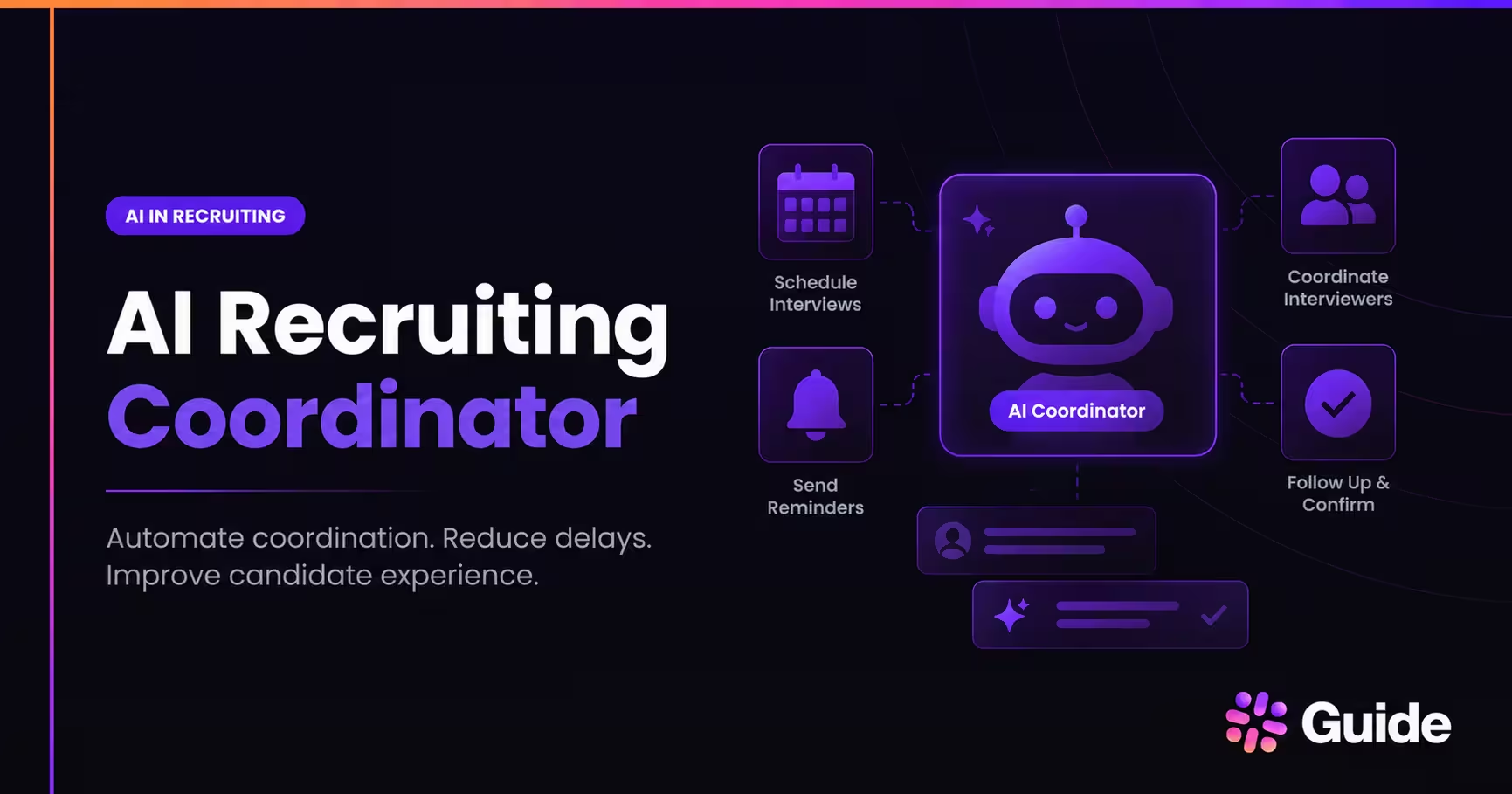
That is the problem we built Guide to solve. Aria is our AI Agent for Recruiting Coordination, and our goal with it is simple: automate the most complex interview scheduling workflows and increase your coordination speed by up to 7x. Instead of a coordinator manually finding times, sending confirmations, and chasing reschedules, Aria handles the repetitive parts of that workflow directly, while you stay in control of anything that needs a human judgment call.
We built Aria because most teams using typical interview scheduling tools still waste over 40% of their time on manual tasks, even when those tools are supposed to be automated. Solving the category-level problem described above only matters if it actually removes work from a coordinator's day, so that is what we optimized for.
What Aria automates
Aria's capabilities break down into a few areas:
- Panel interviews. Aria is purpose-built for complex scheduling scenarios. It finds optimal time slots and interviewers for multi-person panels and learns individual interviewer and recruiter preferences along the way.
- Rescheduling. When an interviewer declines, Aria automatically finds a replacement interviewer, updates calendar files, and notifies everyone. It also learns from decline reasons by asking interviewers directly, which helps cut down repeat conflicts.
- Interviewer conflicts. When calendar conflicts come up, Aria proposes and initiates chats with internal stakeholders to negotiate availability, while you keep full visibility and control over every interaction.
- Calendar hygiene. Aria proactively communicates with interviewers to keep working hours, out-of-office status, time zone changes, and load preferences current, which reduces reschedules and increases interviewer RSVP rates.
- Interviewer load balancing and training. We automate load balancing to prevent interviewer burnout, and track interviewer training paths from first shadow to fully trained.
- Candidate communication. Our branded candidate portal and messaging system deliver a polished, on-brand experience from invitation to offer.
- Collaborative ticketing. Our shared ticketing queue is built for recruiting coordination teams, so tasks stay visible across the team instead of living in individual inboxes.
- Reporting. Our enterprise-grade reporting tracks interviewer and coordinator efficiency, decline reasons, and other pipeline metrics.
How this compares to a traditional scheduling tool
Here is how we think about the difference between typical scheduling tools and what we have built:
This is our own view of the difference, not an independent test of every tool on the market, so weigh it against your own team's actual workflow.
Where it fits in your stack
We integrate with the tools recruiting teams already use day to day, including Greenhouse for the ATS, Gmail for email, Google Calendar, Slack for messaging, Zoom for video, and CoderPad for assessments.
Who this is built for
We built Guide for a specific kind of team: recruiting operations and coordination teams running high volumes of interviews, often with complex, multi-person panels, tight time-to-hire targets, and a strong focus on candidate experience. Teams at GitLab, Netlify, MongoDB, Glossier, and NexHealth, among others, use Guide today.
If your hiring process is simple, low-volume, or handled by a single recruiter without a dedicated coordination function, a full AI recruiting coordinator may be more than you need right now. We built Guide for teams where coordination itself has become the bottleneck.
What our customers say
Cristina Disch, Global Candidate Experience Manager at MongoDB, told us: "There was a pre-Guide MongoDB and a post-Guide MongoDB. Coordination and candidate experience was extremely painful before you guys came along."
Elle Loberternos, Talent Operations Manager at Strava, told us: "We've used every scheduling tool on the market and Guide is far and away our favorite. We are superfans."
Stephanie Lehman, Recruiting Manager at Glossier, says: "We used to spend a crazy amount of time juggling calendars. Guide freed up countless hours a week for us and significantly increased the bandwidth of our coordinators." Kimberly Prelosky, Senior Manager of TA Operations at Duolingo, adds: "We get email after email from candidates saying, 'This is so cool! I've never seen anything like this before.' And it's more automated than any tool we've used in the past. We're huge fans."
You can read the full stories, including how Glossier, GitLab, Netlify, and NexHealth use Guide, on our customer stories page.
Security and compliance
We are SOC 2 audited and certified, GDPR and CCPA compliant, and we encrypt all data at rest and in transit with strict access controls.
Frequently asked questions
Is an AI recruiting coordinator the same as a scheduling link tool like Calendly?
No. A scheduling link tool finds one open slot between two calendars. An AI recruiting coordinator is built for multi-person interview panels, ATS-linked workflows, interviewer load balancing, and candidate communication across an entire hiring process, not a single meeting.
Is an AI recruiting coordinator meant to replace human coordinators?
No. Aria automates the repetitive, manual pieces of coordination work, like finding times, sending confirmations, and chasing reschedules, while your recruiting coordinators keep control over decisions that need human judgment. We built Aria so RCs remain in control for perfect accuracy.
How is this different from an ATS?
An applicant tracking system manages the overall hiring pipeline: job postings, applications, and candidate stages. Aria focuses specifically on the scheduling and coordination layer, and works natively inside an ATS like Greenhouse rather than replacing it.
How does Aria handle a declined interview?
When an interview is declined, Aria automatically finds a replacement interviewer, updates the relevant calendar files, and notifies everyone involved. It also asks the interviewer for their decline reason so we can help reduce repeat issues.
How much time can an AI recruiting coordinator save a hiring team?
It depends on interview volume and panel complexity, but scheduling and rescheduling are consistently among the most time-consuming recruiting tasks industry-wide. On our own platform, teams use Aria to increase coordination speed by up to 7x versus manual scheduling.
What does Guide integrate with?
We integrate with Greenhouse for the ATS, Gmail for email, Google Calendar, Slack, Zoom, and CoderPad.
How hard is it to roll out?
Rather than requiring complex interview requirements to be configured upfront, Aria infers from each user's behavior and automatically suggests interview requirements to save as templates. The more interviews you schedule through your ATS integration, the more it remembers.
Is Guide secure?
Yes. We are SOC 2 audited and certified, GDPR and CCPA compliant, and we encrypt all data at rest and in transit.
See it in action
If interview scheduling has become the bottleneck in your hiring process, we would love to show you how Aria handles it firsthand. Book a demo or read more about our AI Scheduler and scheduling automation use case.