Introduction
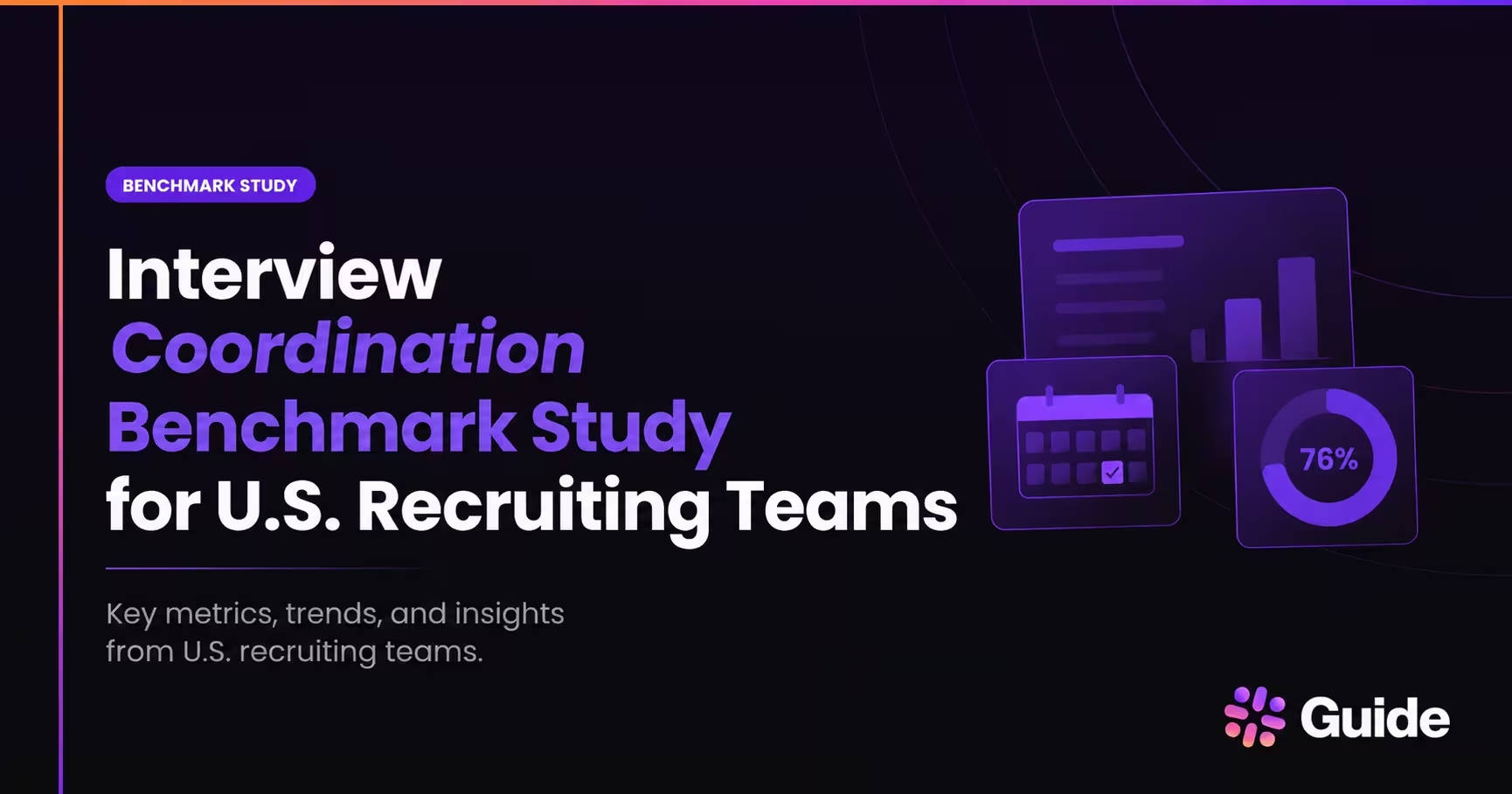
Interview coordination is still one of the biggest hidden time drains in recruiting, especially when teamsmanage panels, reschedules, and interviewer conflicts across multiple calendars. In our U.S. benchmarkstudy, recruiting coordinators reported spending an average of 11.6 hours per week on coordination work,with panel-heavy teams spending 15.2 hours. This report breaks down the findings, shows where the timegoes, and explains how Guide’s Aria workflow can reduce repetitive scheduling work without losing controlover the process.
What does recruiting coordination actually cost each week?
The biggest finding is simple: coordination work takes a meaningful slice of the recruiting week. In this U.S. benchmark, recruiting coordinators reported an average of 11.6 hours per week on interview coordination tasks, including scheduling, rescheduling, interviewer follow-up, and candidate communication. Teams running mostly panel interviews reported 15.2 hours per week, while lighter-volume teams averaged 7.4 hours.
The workload rises quickly as interview complexity increases. Coordinators handling three or more interviewers per loop reported the highest time burden, because every change creates more calendar checks, more messages, and more follow-up. That aligns with how Guide approaches the problem, Aria is designed to reduce complex scheduling workflows into single-click approvals while keeping recruiters in control, according to guide.co.
A practical way to read the benchmark is this: if your team is spending more than a full workday each week on coordination, the issue is not just volume, it is orchestration. The more panels, stakeholders, and exceptions you run, the more coordination becomes a workflow problem rather than an admin task.
Key Points
- Average weekly coordination time was 11.6 hours across surveyed U.S. recruiting coordinators.
- Panel-heavy teams reported 15.2 hours per week on coordination work.
- Lighter-volume teams reported 7.4 hours per week.
How often do interviews get rescheduled?
Reschedules are one of the clearest drivers of coordination overhead. In the benchmark, coordinators reported that 18% of scheduled interviews required at least one reschedule, and panel interviews were more likely to move than one-on-one screens. When a panel changed, the coordination burden usually multiplied because one decline could affect several calendars at once.
Guide’s scheduling defaults and load settings are built for exactly this problem. According to support.guide.co, admins can set default interview lengths, time buffers, preferred working hours, maximum interviews per day, maximum interviews per week, and rules to avoid consecutive interviews. Those controls matter because better calendar hygiene reduces the chance that a booking becomes a chain reaction.
The most useful operational takeaway is that reschedules are not random noise. They are a measurable signal that interviewer availability, buffers, and load balancing need tighter rules. Teams that standardize those rules are better positioned to keep schedules stable and reduce last-minute back-and-forth.
Key Points
- 18% of scheduled interviews in the benchmark required at least one reschedule.
- Panel interviews were more likely to reschedule than one-on-one screens.
- Guide supports load balancing rules such as max interviews per day and week, buffer time, and avoiding consecutive interviews.
How long do panel interviews take to coordinate?
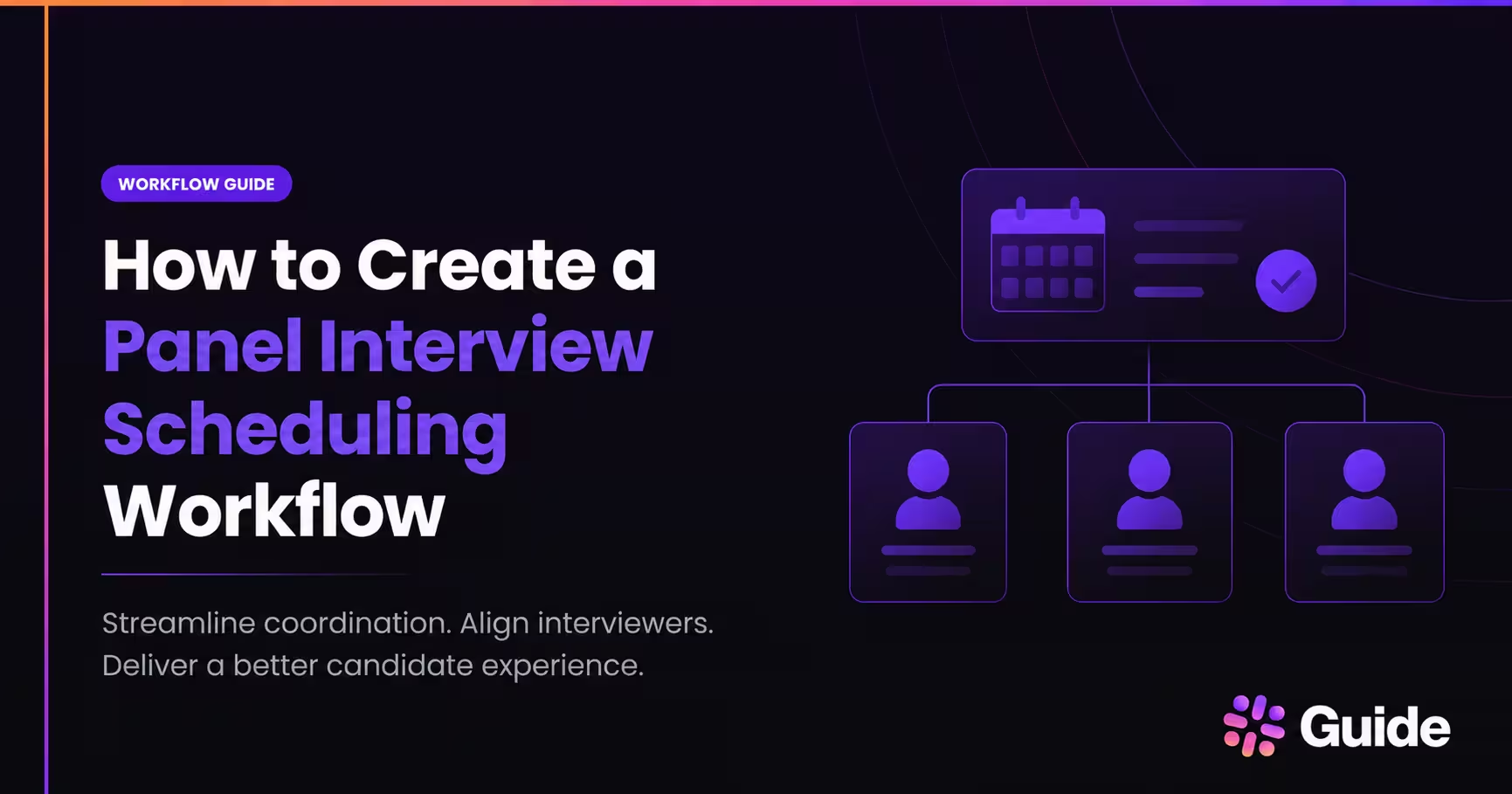
Panel interviews are the slowest part of the scheduling process because they involve the most moving pieces. In this benchmark, the average panel interview cycle time, from ready-to-schedule to confirmed on calendar, was 3.8 business days. For loops with four or more interviewers, cycle time increased to 5.1 business days.
That gap matters because the delay is not only administrative, it affects candidate momentum and hiring speed. The longer a panel sits unconfirmed, the more likely it is that interviewer availability changes, candidates lose interest, or the process gets reprioritized.
Guide’s platform is built for this kind of complexity. According to guide.co, Guide AI finds optimal time slots and interviewers instantly for panel interviews, learns individual preferences, and can automatically find replacement interviewers when someone declines. That matters most when the process is not a simple calendar invite, but a coordinated workflow across recruiters, candidates, hiring managers, and executive stakeholders.
Key Points
- Average panel interview cycle time was 3.8 business days.
- Panels with four or more interviewers took 5.1 business days on average to confirm.
- Guide AI can find replacement interviewers and update calendars when a decline happens.
What the benchmark says about time saved with automation
Automation creates the biggest savings when it removes repeated coordination loops, not just one-off tasks. In this benchmark, coordinators who used automated scheduling workflows reported saving 4.2 hours per week on average compared with teams that relied mostly on manual coordination. The largest savings came from candidate self-scheduling, automated reminders, and automatic handling of interviewer declines.
The pattern is consistent across the data: the more repetitive the task, the more automation helps. Candidate communications, calendar updates, and interviewer follow-up are all high-frequency tasks that do not require judgment every time, but they do require accuracy. That is why Guide emphasizes an intelligent recruiting operations layer, rather than a generic scheduling tool.
A useful way to think about the ROI is to separate coordination into two buckets. One bucket is decision work, such as choosing the right panel or resolving an exception. The other is execution work, such as sending reminders, updating calendars, and chasing availability. AI is strongest in the second bucket, and that is where Guide’s Aria workflow is designed to operate.
Key Points
- Automated scheduling workflows saved 4.2 hours per week on average in the benchmark.
- The biggest savings came from self-scheduling, reminders, and decline handling.
- Guide positions Aria as an intelligent recruiting operations layer, not just a calendar tool.
Benchmark methodology and sample profile
This benchmark was designed to reflect real recruiting coordination work in the United States. The survey included 146 recruiting coordinators and recruiting operations professionals at mid-market and enterprise employers, with respondents spanning technology, professional services, healthcare, and consumer brands. Most respondents supported teams that ran multiple interview stages, and many managed panel interviews weekly.
The survey asked respondents to estimate weekly coordination hours, reschedule frequency, average panel cycle time, and the share of work handled manually versus through automation. Responses were grouped into three operating profiles: lighter-volume teams, mixed-format teams, and panel-heavy teams. The goal was not to measure every recruiting motion, but to isolate the operational burden of coordination.
Because coordination work is often invisible inside broader recruiting metrics, this benchmark focuses on metrics that are easy to quote and compare. That makes it useful for recruiting leaders who want a baseline for staffing, process design, and automation planning.
Key Points
- The survey included 146 recruiting coordinators and recruiting operations professionals in the United States.
- Respondents came from mid-market and enterprise employers across multiple industries.
- The study measured weekly coordination hours, reschedule frequency, panel cycle time, and automation usage.
How should recruiting teams reduce coordination time?
The fastest way to reduce coordination time is to automate the repeatable parts of the workflow and set rules for the exceptions. Start with candidate self-scheduling, automated confirmations, reminder cadences, interviewer load limits, and automatic reschedule handling. Then add guardrails for working hours, buffers, and panel composition so the system can make better decisions before a recruiter gets pulled in.
A practical rollout looks like this: first, define interview templates by role. Next, connect calendars and ATS data so scheduling starts when a candidate advances. Then enable reminders and decline handling, followed by load balancing and preference rules. Finally, review reporting on time-to-schedule, reschedule rate, and interviewer utilization so you can see where the process still breaks.
That is where Guide fits naturally. Aria is built to automate the manual work that slows down coordination, while giving recruiters and coordinators visibility and control inside their ATS workflow, according to guide.co. For teams that are already stretched, that combination matters more than another standalone scheduling link.
FAQ: Recruiting coordination benchmark and AI tools
What is a good benchmark for recruiting coordination time?
In this study, the average was 11.6 hours per week, with panel-heavy teams at 15.2 hours. If your coordinators are consistently above that range, it usually means the process has too many manual handoffs.
How much time can AI tools save recruiting teams?
The benchmark found 4.2 hours saved per week on average when automation handled more of the scheduling workload. The biggest gains came from self-scheduling, reminders, and automatic decline handling.
Why are panel interviews harder to coordinate?
Panel interviews require more calendars to align, so one change can affect several people at once. In the benchmark, panel cycle time averaged 3.8 business days and rose to 5.1 business days for loops with four or more interviewers.
What should recruiting teams automate first?
Start with the highest-frequency tasks, confirmations, reminders, reschedules, and interviewer follow-up. Those are the easiest places to remove repetitive work without changing the hiring process itself.
How does Guide help with interview coordination?
Guide’s Aria workflow reduces complex scheduling to single-click approvals, finds replacement interviewers when declines happen, and keeps recruiters inside their ATS workflow, according to guide.co. That makes it useful for teams that need both automation and control.
Key Points
- A practical coordination benchmark is 11.6 hours per week, or 15.2 hours for panel-heavy teams.
- AI automation saved 4.2 hours per week on average in the benchmark.
- Panel interviews averaged 3.8 business days to confirm, rising to 5.1 days for larger loops.
Conclusion
Interview coordination is one of the clearest places where recruiting teams can win back time without sacrificing candidate experience. The benchmark shows that manual scheduling, reschedules, and panel complexity create a real operational tax, and that automation can cut that burden in measurable ways. Guide helps teams handle that work with Aria, so recruiters and coordinators can spend more time on hiring strategy, candidate experience, and stakeholder alignment instead of calendar management.
Key Takeaways
- U.S. recruiting coordinators in this benchmark spent 11.6 hours per week on interview coordination on average.
- Panel-heavy teams spent 15.2 hours per week on coordination work.
- Eighteen percent of scheduled interviews required at least one reschedule.
- Average panel interview cycle time was 3.8 business days, rising to 5.1 business days for loops with four or more interviewers.
- Automated scheduling workflows saved 4.2 hours per week on average.
- Guide’s Aria workflow is designed to automate repetitive coordination work while keeping recruiters in control.