Summary
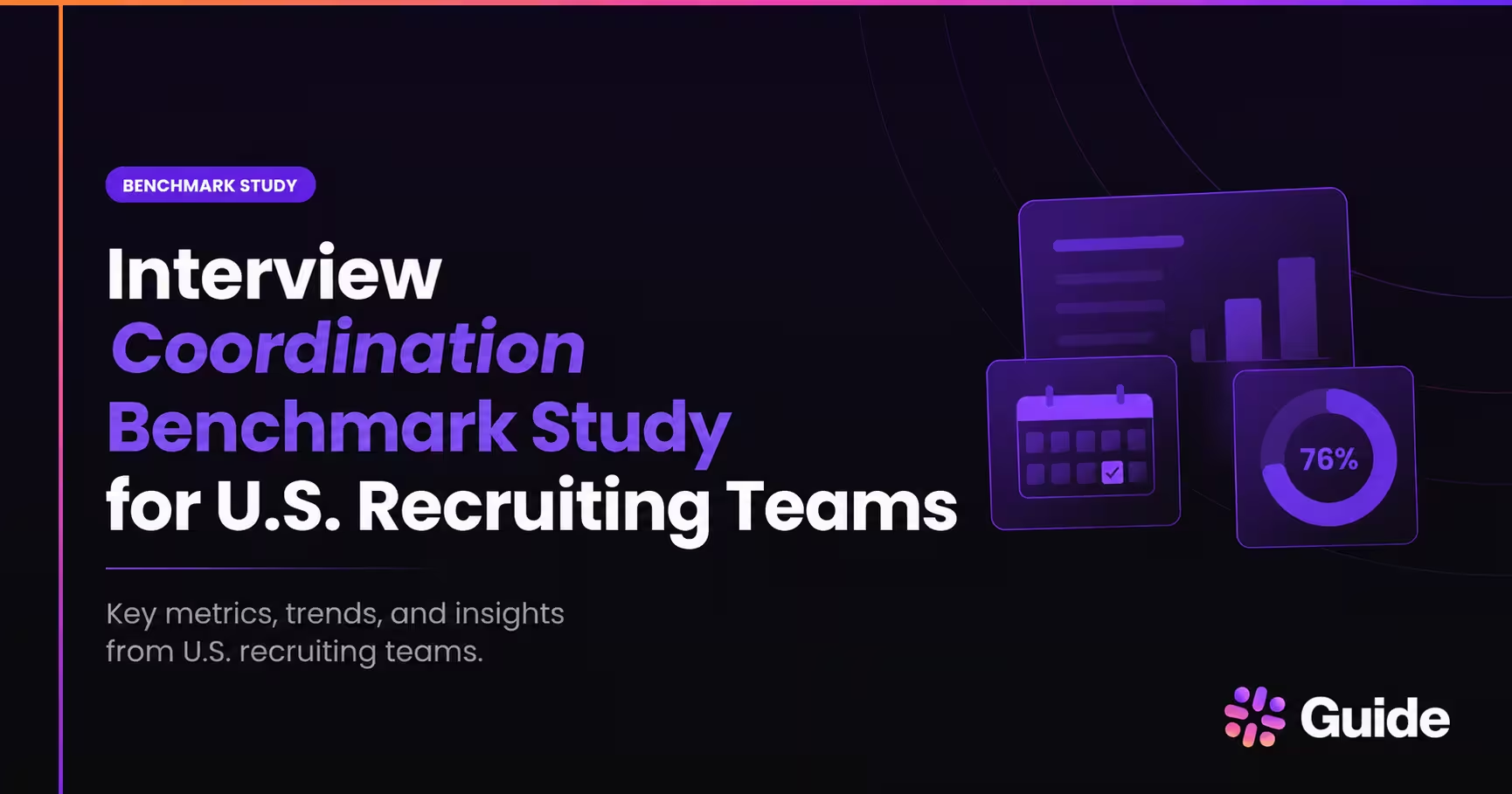
No single industry benchmark exists for interview coordination time, but published data (SHRM 2025, SelectSoftwareReviews 2026) shows scheduling consumes 35% of recruiter time, 60% of companies saw longer time-to-hire in 2024 (up from 44% in 2023), and 27% of TA leaders call workload unmanageable (up from 20%). Panel-specific benchmarks don't yet exist publicly.
Where this data comes from
We pulled the numbers in this piece from two sources: SHRM's 2025 Recruiting Executives Benchmarking report, based on a survey of 2,371 SHRM members fielded between January and March 2025, and a 2026 recruiting statistics report from SelectSoftwareReviews. Both are neutral, third-party sources rather than vendor-published marketing claims, and both are linked here so you can check the numbers yourself. We did not run our own primary survey for this piece, and we are not presenting these figures as an original Guide study. Where we could not find a reliable public number for something, we say so directly instead of guessing.
How much of a recruiting team's time goes to scheduling
According to SelectSoftwareReviews, 35% of recruiters' time goes to interview scheduling alone, one of the single biggest line items on a recruiter's calendar. That figure does not distinguish between a simple one-on-one screen and a five-person panel loop, but it is a useful floor: even before panel complexity enters the picture, more than a third of a typical recruiting week is already going to scheduling.
Why the workload keeps climbing
The same report found that 60% of companies saw their time-to-hire get longer in 2024 than the year before, up from 44% of companies in 2023, and that 27% of talent acquisition leaders now describe their team's workload as unmanageable, up from 20% the year before that. SHRM's 2025 benchmarking data adds a complementary data point: median time-to-fill across U.S. employers was about a month and a half for both executive and nonexecutive roles in 2025, and organizations with dedicated recruiters managed a median of 20 requisitions a year overall, rising to 50 at large organizations and 60 at extra-large organizations. None of that time is spent exclusively on coordination, but a heavier requisition load and a slower funnel both point toward more interviews to coordinate, not fewer.
Why panel interviews are the hardest part to benchmark
This is the honest gap in the public data: we could not find a reliable, neutral, third-party benchmark that isolates panel-interview scheduling time specifically, in days or hours, the way SHRM isolates time-to-fill or SelectSoftwareReviews isolates share of recruiter time. What we can say with confidence, based on the mechanics of the problem rather than a specific study, is that panel scheduling compounds. A one-on-one interview needs one open slot between two calendars. A four- or five-person panel needs every required panelist's calendar to align at once, plus a backup plan for whoever declines. If your team is already spending over a third of its time on scheduling in general, per the SelectSoftwareReviews figure above, it is reasonable to expect that share to climb further once panels enter the picture, even without a precise multiplier to cite.
What this means for staffing and process design
Two things follow directly from the data above, without needing to extrapolate further than the numbers support. First, if scheduling already claims roughly a third of recruiter time industry-wide, a team running high interview volume or heavy panel loops should expect coordination to be a larger, not smaller, share of the week, and should plan headcount and tooling accordingly. Second, since 27% of talent acquisition leaders already describe their team's workload as unmanageable, adding more panel complexity without adding automation or support is likely to push that number higher rather than resolve on its own.
Where automation actually helps
This is the specific gap we built Aria, our AI Agent for Recruiting Coordination, to close. Aria is purpose-built for multi-day panels and virtual and hybrid interviews, and it learns from previously scheduled panels to save them as repeatable templates. When an interviewer declines, Aria automatically finds a replacement interviewer, updates the relevant calendar files, and notifies everyone involved, instead of a coordinator restarting the search from scratch. When a calendar conflict comes up, Aria proposes and initiates chats with the interviewers involved to negotiate availability, while a recruiter keeps full visibility and control. We also automate interviewer load balancing to help prevent burnout, and our AI-enhanced interviewer preferences and time zone detection keep availability current automatically. On the candidate side, our branded portal and messaging deliver confirmations, interviewer bios, and prep information without manual follow-up, and everything runs natively inside Greenhouse.
Benchmarks at a glance
How to read these numbers for your own team
- Track your own time-to-schedule and reschedule rate before assuming your team matches any published average.
- Separate one-on-one scheduling time from panel scheduling time in your own reporting, since public benchmarks mostly blend the two.
- Treat the 35% scheduling-time figure as a floor, not a ceiling, if panels make up a large share of your interview volume.
- Revisit staffing and automation decisions if your own workload is trending toward the 27% of teams that already describe their workload as unmanageable.
Frequently asked questions
Is there a reliable industry benchmark for hours spent on interview coordination per week?
Not a granular, hours-per-week figure from a neutral source that we could verify. The closest reliable public data point is SelectSoftwareReviews' finding that 35% of recruiters' time goes to interview scheduling overall, which is a share of the week rather than a fixed hour count.
How much of a recruiter's time goes to scheduling?
According to SelectSoftwareReviews' 2026 recruiting statistics report, 35% of recruiters' time goes to interview scheduling.
Is there good public data on panel interview scheduling time specifically?
Not that we could find from a neutral, verifiable source. Panel scheduling is mechanically harder than one-on-one scheduling because it requires multiple calendars to align at once, but we don't have a specific, citable day or hour figure for that complexity and would rather say so than invent one.
What is the median time-to-fill for U.S. employers?
According to SHRM's 2025 Recruiting Executives Benchmarking report, median time-to-fill was about a month and a half for both executive and nonexecutive positions in 2025.
How does Aria help with coordination workload?
Aria automates the repetitive parts of panel scheduling: finding replacement interviewers after a decline, negotiating conflicts with interviewers, balancing interviewer load, and keeping candidates updated, while a recruiter stays in control of anything that needs a judgment call.
See it in action
If interview coordination has become a bigger share of your team's week than it should be, we would love to show you how Aria handles it. Book a demo or read more about our AI Scheduler.